
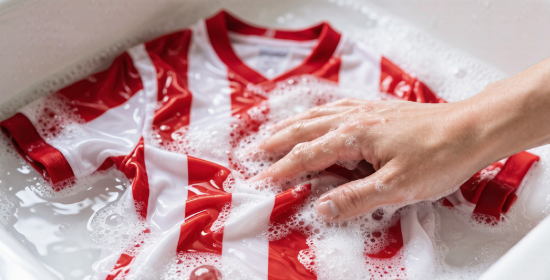
If you’ve ever pulled a favorite kit out of the wash only to find the badge cracked or the colors dulled, you’re not alone. After analyzing the top-ranking articles for “best way to wash football shirts,” “how to keep soccer jerseys looking new,” and “how to protect soccer jersey print,” a few practices show up again and again across nearly every high-ranking source. Here’s what the data says works.
1. Turn It Inside Out — Every Single Time
This is the single most repeated tip across all three keyword clusters. Multiple guides explain that most kits carry heat-pressed or screen-printed badges, sponsor logos, and numbers, and washing right-side out lets these rub against the drum or other clothes, causing cracking and peeling. Turning the jersey inside out also has a secondary benefit: it exposes the inner fabric — where sweat and body oil concentrate most — directly to detergent and water for a more thorough clean.
2. Wash Cold, Never Hot
Every top-ranking article agrees on temperature. Recommendations cluster around 30°C (86°F) maximum, with several sources advising to go even cooler for older, printed, or vintage shirts. One detailed guide breaks it down using the standard care-label dot system: one dot = 30°C, two dots = 40°C, and so on, and stresses checking your label rather than guessing. Heat is consistently named as the number one cause of shrinkage, color fade, and print cracking — polyester-based kits are especially heat-sensitive.
3. Use the Gentle/Delicate Cycle and Low Spin
Beyond temperature, spin speed matters. Guides recommend a delicate or gentle cycle with reduced spin, since high agitation and fast spinning stress seams and printed areas. A mesh laundry bag is a frequently cited add-on — it prevents the jersey from catching on zippers, buttons, or rougher fabrics in the same load.
4. Skip the Fabric Softener and Bleach
This is a near-universal warning across the research: fabric softener coats fibers in a way that can weaken the adhesive bond holding on prints and heat-pressed lettering, causing them to peel faster. Bleach and other harsh, alkaline detergents are flagged even more strongly — they’re linked to permanent discoloration and accelerated print damage. A mild, color-safe detergent (ideally powder over liquid, according to one source) is the consistent recommendation.
5. Pre-Treat Stains Before They Set
Several sources give near-identical stain protocols:
- Sweat and general odor: add a cup of white vinegar to the wash — it breaks down odor-causing residue without leaving a smell once rinsed.
- Mud/grass stains: let mud dry fully first, brush it off, then pre-soak the area in cold water with a little detergent; a diluted vinegar solution helps break down grass pigment specifically.
- Blood stains: dab with hydrogen peroxide, which reacts chemically with blood and lifts it without harsh scrubbing.
- Tough or set-in stains: a soak of roughly 10–20 minutes (some sources suggest up to an hour, or overnight for heavily soiled kits) loosens dirt before the main wash.
One expert-sourced NBC piece — citing a Procter & Gamble fabric care scientist — notes that most modern jerseys are made from performance polyester designed to wick moisture and hold color through repeated washes, but that targeted, gentle cleaning (rather than aggressive scrubbing) is what actually preserves the fibers long-term.
6. Air Dry — Always
Not a single top-ranking article recommends the tumble dryer. The consensus is unanimous: heat from a dryer is the fastest way to shrink fabric, crack heat-pressed numbers, and peel badges. The recommended method is to hang or lay the jersey flat in a shaded area, since direct sunlight and UV exposure can fade colors over time even during drying.
7. Protecting the Print Specifically
For the “how to protect soccer jersey print” audience, a few extra data points stood out:
- Prints are typically heat-pressed vinyl, screen print, or flock, attached with adhesive rather than woven into the fabric — which is why heat and friction are their two biggest enemies.
- If a print or number does start peeling, several guides describe the same at-home fix: place a thin cloth or plain paper over the area and apply a warm iron (no steam) for 10–30 seconds to re-melt the adhesive and reseat it, repeating gradually rather than using high heat all at once.
- For storage, the recurring advice is to fold rather than hang jerseys long-term (hanging can stretch the fabric), keep them in a cool, dry place away from sunlight, and use breathable garment bags instead of plastic, which can trap moisture and cause mildew.
Quick-Reference Checklist
| Step | Recommendation |
|---|---|
| Orientation | Turn inside out before washing |
| Water temp | 30°C / 86°F max, colder for vintage/printed shirts |
| Cycle | Delicate/gentle, low spin |
| Detergent | Mild, color-safe; avoid bleach and fabric softener |
| Stain pre-treat | Vinegar (sweat/grass), hydrogen peroxide (blood), 10–20 min soak |
| Drying | Air dry flat or on a hanger, out of direct sunlight — never tumble dry |
| Print repair | Cloth + warm iron, 10–30 seconds, no steam |
| Storage | Fold, breathable garment bag, cool and dry, out of sunlight |
The Takeaway
Across every top-ranking article for these three keywords, the underlying theme is the same: heat and friction are the two things that actually destroy a jersey — not normal wear from playing in it. Cold water, a gentle cycle, no dryer, and turning the shirt inside out will do more to keep a kit looking new than any specialty product on the market.
This article was compiled from a review of the current top-ranking search results for “best way to wash football shirts,” “how to keep soccer jerseys looking new,” and “how to protect soccer jersey print,” including guides from Castore, Net World Sports, TOFFS, Storelli, NBC Select, and others.